
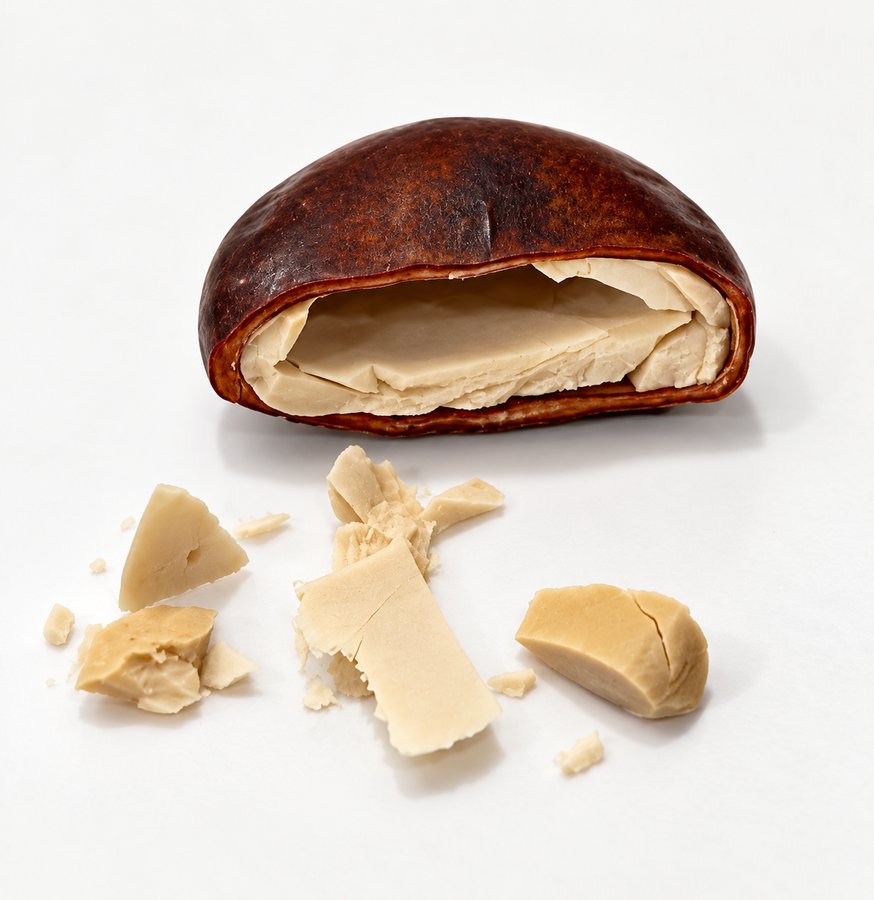
The first oneirogen I ever consciously tested was also one of the worst things I have ever tasted. Years before this structured run, I cracked open an entire Entada rheedii seed, probably around 20 grams of kernel, and ate it raw. It tasted profoundly soapy, and it was so astringent that my sense of taste was off for days afterward. The seed contains saponins, which may explain the soapiness. I would not repeat that experiment, and this entry exists partly to record why.
Entada rheedii is a woody climbing vine from tropical Africa, Asia, and northern Australia. Its pods are the dramatic part: flat, segmented, and up to two meters long, each holding a row of hard brown seeds about 50 by 35 millimeters. The seed coat is thick enough to survive months at sea, which is why these turn up on beaches far from any vine and go by the name giant sea bean. In South Africa it grows in KwaZulu-Natal, where isiZulu names include inkwindi and umbhone, and traditional healers use it to induce vivid dreams for communicating with ancestors. As with most of the plants in this matrix, there is no clinical literature on what it does to sleep or dreaming. The evidence is ethnobotanical, and the mechanism is unknown.
Reliable preparation guidance is thin. The South African National Biodiversity Institute describes healers powdering the dried seed and smoking it in a pipe before bed. Direct ingestion of the inner meat shows up in secondary accounts. Tea and boiling mostly appear in modern seller instructions, which are the least trustworthy layer. Food-use records point the other way entirely: in Australia the seeds are leached in water to remove toxic secondary metabolites, then cooked, before anyone eats them. So there is no standardized protocol, and a whole raw seed is not obviously safe. My earlier taste episode fits that picture.
For this seven-night retest I used five grams of pulverized seed stirred into water. The first four nights were taken before bed. The last three were taken at a 3 a.m. wake-back-to-bed. Chamomile tea was added from night three onward, one gram for two nights and then half a gram, which I flag now because it complicates everything after it. No journaling techniques and no other dream practices were used.
Nights one and two showed nothing. Recall scored 2 and then 3, vividness sat at 3, and sleep quality was a 3 both nights. On night one I had eaten close to bedtime and had alcohol earlier, so it was a weak night for the seed to show anything.
Dream density picked up on night three and rose further on night four, which scored 4 on recall, 4 on vividness, and 4 on emotional intensity. The two strongest nights were nights five and seven, both wake-back-to-bed nights on an empty stomach, each scoring 4 across recall, vividness, and narrative coherence. Night six dipped back to 3 across the board. It was also the one wake-back-to-bed night where I had eaten calories unusually close to bedtime.
Across the run, recall averaged 3.3 out of 5 and vividness 3.4, against a baseline of roughly 3 for each. Narrative coherence and emotional intensity both averaged 3.3. Hypnagogic imagery stayed at 1 all seven nights. Lucidity stayed at 1 all seven nights. Sleep quality was a 3 every single night, so the seed neither sedated me nor disrupted anything.
The pattern that stands out is timing. The two weakest nights were the two nights with food close to bedtime, and the strongest nights came after moving the dose to 3 a.m. That is consistent with the seed doing something modest when it lands on an empty stomach late in the sleep cycle. It is also consistent with wake-back-to-bed doing the work on its own, since a mid-sleep wake tends to lift recall regardless of what is swallowed at the time. This run cannot separate those two explanations.
The confound list is long. Chamomile entered on night three, right when scores began to move. Alcohol was present on nights one, four, and six. Kiwi and tart cherry juice were both present on nights four and five, the two nights with the highest emotional intensity scores. Each of those has at least a folk reputation for affecting sleep, and I did not control for any of them.
What I am willing to say is narrow. Entada rheedii may have increased dream density in the back half of the week, at a level that recall and vividness scores picked up as roughly half a point above baseline. It produced no lucidity and no change in hypnagogic imagery. The mild lift is real in the numbers and unattributable in practice. Before this seed earns a stronger rating it needs a cleaner test with no chamomile, no fruit, and no alcohol, and it needs a preparation method with better grounding than a vendor listing. Smoking is the one route with a documented traditional basis. Whether that is worth testing is a separate question I have not answered yet.